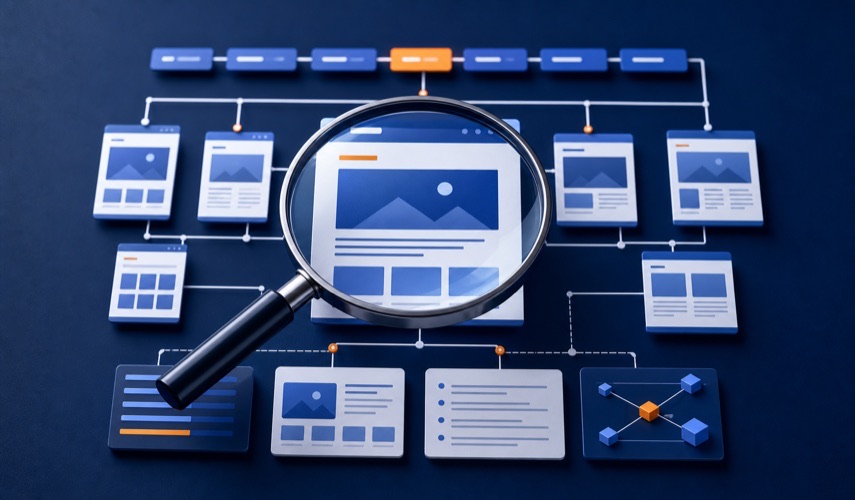
What is website SEO structure?
Website SEO structure is the organization and linking of pages so people can find answers and search engines can discover and understand the content. It includes page hierarchy, navigation, URLs and contextual internal links. An XML sitemap lists URLs for search engines; it does not replace useful navigation or links within the content.
Start with the company's actual offer and its customers' questions, not a list of keyword variations. A separate page makes sense when it serves a distinct need and has useful content of its own. Near-identical pages with different city names do not create a useful architecture.
Build a content map before design
- List genuine services, existing pages and questions customers ask.
- Give each proposed URL an audience, a primary question and a next step.
- Separate commercial pages from guides: a service page explains the engagement, while an article helps readers understand a topic.
- Connect each service to relevant completed work and an inquiry path. Include language counterparts for a bilingual site.
- Check that available copy, photographs and CMS fields support the map before choosing and customizing the visual foundation.
A simple document with columns for page, purpose, content, related URLs and content owner is enough to start. It reveals empty pages and missing information before those gaps hold up the launch.
A real example: service, project and inquiry
On this website, the accommodation website service explains what a property owner needs. The Cape Pines Motel case study documents a completed website with a CMS, galleries, room filtering and a booking form. The inquiry form collects requirements for a new project. These pages support one another without trying to do the same job.
Hotel Heritage provides another documented example. Rooms and suites, restaurants, conference facilities and news need distinct content areas. Its PHOBS integration belongs to that specific project; it is not a feature to assume for every accommodation website. The architecture should reflect the agreed scope, not an imagined offer.
Make internal links useful
Place a link where the destination answers a natural follow-up question. A label such as “accommodation website example” gives more context than repeated “click here” links. Important pages should be reachable through normal HTML links, not only through site search or a button that depends on a script to reveal content.
On an existing website, look for pages without incoming internal links, links to retired URLs and navigation that groups unrelated services. Google's link best practices explain crawlable links and meaningful anchor text. There is no need to force a link into every paragraph.
A practical map: from a service to a specific answer
- Website development explains the process and engagement scope.
- The CMS selection guide addresses how the team will manage content.
- The pricing guide helps readers compare packages and required functionality.
These pages should not repeat the same title and introduction. Each answers a different question; links belong where the reader naturally moves to the next decision. If a useful guide is listed only in the sitemap, identify the service or related article from which a visitor would need it and add a link with a relevant explanation.
When should similar pages be merged?
Two URLs appearing for the same Search Console query are not automatically a problem. Read both pages: do they answer the same question, repeat the same advice and lead to the same decision? If so, combine their useful material on a chosen URL, permanently redirect the retired page, then update internal links and sitemaps.
A service selection page and a technical implementation guide can remain separate. Their headings and introductions should make that distinction clear. Do not remove useful content simply because it has no clicks yet.
Pre-launch structure checklist
- Each important page has a clear title and a distinct purpose.
- Menus, breadcrumbs and contextual links point to the intended URLs.
- Canonical URLs and reciprocal language links are correct.
- The sitemap contains active pages, not retired or redirected articles.
- Structured data describes visible content, without invented ratings or FAQ entries.
- Mobile visitors can read the offer, inspect an example and submit an inquiry.
Advanced SEO structure makes a website easier to understand and maintain, but it does not guarantee rankings. For project-specific planning, review our website SEO structure service and prepare your existing URLs, main services and examples of actual content.
Planning a similar project?
If you want to apply this advice to your business website, review the related services or send a short inquiry so we can estimate the scope.