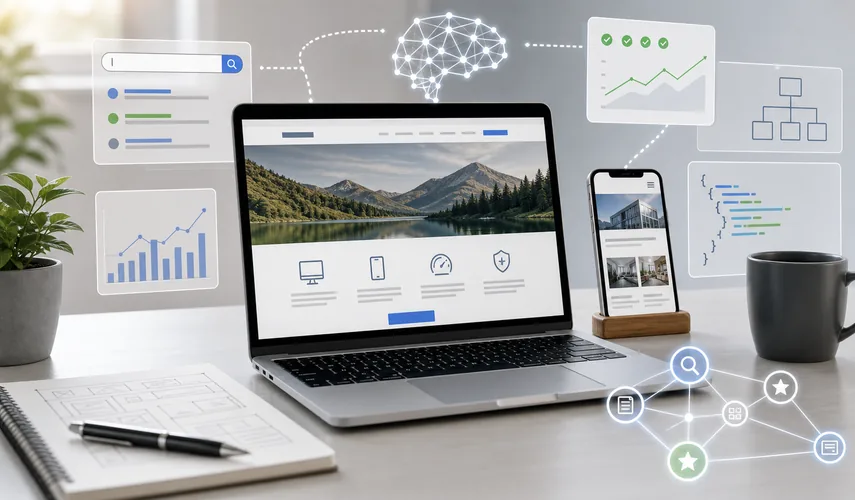
A practical guide for businesses that want stronger visibility in Google Search, AI Overviews, and other AI tools.
What is AI SEO and why does it matter for website development?
AI SEO is not a completely separate discipline from classic search engine optimization. It is a broader way to prepare website content, technical structure, and trust signals for Google Search, AI Overviews, AI Mode, and other tools that answer user questions directly.
Google Search Central explains that generative AI features are still connected to core Search ranking, indexing, and quality systems. In practical terms, a website must first be clear for users and search engines before it can become a strong candidate for AI search visibility.
For companies planning website development, this means SEO should not be left until the end. Page structure, headings, internal links, schema markup, loading speed, image optimization, and useful copy should be part of the project from the start.
AI search needs clear answers, not keyword repetition
Old SEO often focused too heavily on repeating keywords. That is no longer enough. A user may ask which website package is right for a company, why a CMS matters, how responsive design affects conversions, or how a service or product catalog should organize categories. Strong content answers these questions clearly and from real experience.
This is why service pages, package pages, portfolio pages, and blog posts should be written around actual user intent. Instead of one generic page trying to rank for everything, a better website has connected topic pages for business websites, service or product catalogs, custom web applications, SEO structure, maintenance, and optimization.
1. Organize content around real client questions
AI tools and search engines can understand a page more easily when the subject is focused. Every important page should have one main goal, a precise H1 heading, logical subheadings, and answers that help the visitor make a decision.
- On package pages, explain who the Business website, Catalog website, and Custom web system packages are for.
- On portfolio pages, show the goal of the project, the type of solution, and the included functionality.
- On the blog, answer questions clients usually ask before they send an inquiry.
- On the contact page, make it clear what information the visitor should send.
This type of content is better for SEO and better for users because it reduces uncertainty before the first contact.
2. Use schema markup, but do not overdo it
Structured data helps Google understand what a page represents: a blog article, an organization, breadcrumb navigation, an image, business details, or a service. Google says structured data is not a special shortcut for generative AI search, but it remains useful as part of an overall SEO strategy because it can support rich results and clearer page understanding.
For a business website, the most useful schema types are often:
- Organization or LocalBusiness for company details.
- BreadcrumbList for page hierarchy.
- BlogPosting for blog articles.
- ImageObject for important blog and portfolio images.
- Service or a clear service structure for service pages.
The key rule is simple: structured data should describe information that is actually visible to the visitor.
3. Show experience, references, and clear business details
AI tools often need to understand whether a source is trustworthy. A website should clearly show who is behind the content, what the company does, and what type of projects it has delivered. This does not mean writing long filler text. It means giving context for important claims.
For example, a portfolio can be more than a visual gallery. Each project can explain the website goal, solution type, functionality, technologies, and business context. That naturally builds trust and gives search engines stronger expertise signals.
4. Keep the technical foundation clean
If a page is not accessible, loads slowly, has duplicate URLs, or blocks important resources, even great content will have limited impact. For AI SEO and classic SEO, the following details matter:
- indexable HTML content that is not hidden only behind JavaScript,
- a correct canonical URL for every page,
- an XML sitemap with important pages and images,
- responsive layout and readable mobile content,
- optimized images with useful alt text,
- fast loading and stable layout without unexpected shifts.
In practice, responsive web design, performance, and SEO structure are not separate items. They are parts of the same user experience.
5. Is llms.txt enough for AI tools?
llms.txt can be useful as an additional guide for some AI tools and as a clean overview of important website pages. Still, it should not be treated as a replacement for a good website. Google states that a special AI file is not required for Google Search or generative AI features, and that llms.txt is not a special ranking signal for Google Search.
The best approach is straightforward: first improve what users and Google can see on the website, then add additional machine-readable files if they are useful for other systems.
6. Write content that helps the visitor decide
Good website copy should answer the user question and move the visitor closer to the next step. On a package page, it is not enough to say that SEO is included. It is better to explain what that includes in practice: heading hierarchy, meta titles and descriptions, schema markup, optimized images, clean URLs, sitemap, and pages that answer specific search intent.
That is why a website package should be chosen according to the project goal, not only according to the number of features. A business website, a service or product catalog, and a custom web application have different SEO needs.
How Web Design Serbia studio can help
Web Design Serbia studio builds business websites, service catalogs, and custom web solutions with clear structure, responsive design, and advanced SEO setup. The goal is not only to make the website look good, but to help visitors understand the offer, find important information, and send an inquiry.
If you are planning a new website or want your current website to be better prepared for Google and AI search, send a short project description through the contact page. The best SEO result comes when content, design, and technical structure are planned together.
Next step for this topic
For practical application, review website development with advanced SEO structure or complete the website inquiry form if you want an estimate for a concrete project.
Planning a similar project?
If you want to apply this advice to your business website, review the related services or send a short inquiry so we can estimate the scope.